
 Thermochemical Conversion technologies for biochar production


Webinar Details
When:
May 19, 2022 11:00 am US/Eastern
Length: 00:58 (hh:mm)
Advance Registration NOT required.
View now on-demand.
Presenter(s):
- Dr. Chris Saffron - Associate Professor, Michigan State University
Virtual Event Format:
Group Viewing Available:
The US Forest Service in partnership with the US Biochar Initiative and the Southern Regional Extension Forestry will be presenting its next monthly Biochar Webinar titled: "Thermochemical Conversion technologies for biochar production" on May 19, 2022 from 11am to 12pm Eastern time. NOTE: The replay of this live webinar is not available due to technical difficulties. However, the webinar titled "Great Lakes Biochar Network - Production of Biochar" is being substituted in its place as it is substantially the same webinar given by Dr Saffron November 2021.
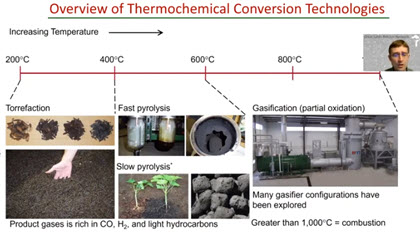
In this on-demand webinar, you will learn about the production of biochar by pyrolysis. This includes biochar production systems ranging from low-tech to high-tech. The infrastructure needs influence the costs associated with starting to produce biochar, and the the price of biochar at retail has a wide range. The primary production parameters are temperature and retention time, and these parameters are important in the determination of the finished characteristics of the biochar. Air emissions are discussed, which are a concern during production and will vary depending on production practices as well.
Our webinar Speaker this month is Dr. Chris Saffron. Dr. Saffron, an associate professor at Michigan State University, holds a Ph.D. on Chemical Engineering and Material Science from Michigan State University.
His research program investigates the use of thermochemical, electrochemical, and catalytic technologies for converting plant biomass into liquid fuels, solid fuels, and higher value products.
His students have developed electrocatalytic techniques for pyrolysis oil stabilization and upgrading to produce hydrocarbon fuels. Using electrocatalytic reduction, the energy upgrading of lignin-derived phenolics to form cyclohexanol and alkyl cyclohexanols is an active area of interest. Recently, his group has begun examining the regional deployment of these deconstruction and conversion technologies in small-scale biomass upgrading depots to balance the competing forces of "economies of scale" and "economies of transportation". Sustainability analyses, including life-cycle assessment and technoeconomic modeling, are performed to better design renewable energy systems and to inform public policy.
His research team is currently working with numerous industrial partners as well as state and federal agencies to better understand the mechanisms controlling the productivity of these technologies and to foster strategies that alleviate the risks associated with their eventual commercialization..
For information about the U.S. Biochar Initiative, click here.
Audio Transcript from the November 2021 Webinar (click here)
Presentation Slides from the live May 2022 webinar(click here)
Additional Resources:
United States Biochar Initiative
US Forest Service (biochar related)
More Biochar related Webinars
The Forest Products Network
Southern Forests (biochar related)
Reforestation, Nurseries, and Genetic Resources
UT Institute of Agriculture - Biochar
University of Georgia - Biochar


 Loading