
Common Garden Studies for Herbaceous Plants: Lessons Learned from the Longleaf Pine Ecosystem


Webinar Details
When:
Jul 26, 2017 11:00 am US/Eastern
Length: 01:02 (hh:mm)
Advance Registration NOT required.
View now on-demand.
Presenter(s):
- Dr. Joan Walker, Research Ecologist, Forest Service, Southern Research Station
Virtual Event Format:
Group Viewing Available:
The fifth in the Eastern Seed Zone Forum's online lecture and discussion series aimed at providing both information about the creation of seed zones in general and a forum in which professionals, experts, and interested parties discuss the possibility of drafting seed zone guidelines for the eastern United States. In this webinar, Dr. Joan Walker, Research Ecologist at the USDA Forest Service Southern Research Station, will describe steps taken to develop the South Carolina Common Garden Study, including seed collection, plug production, garden establishment and design, selection of traits to measure, and data collection.
Where should the seeds for longleaf pine restoration come from? The question seems simple, but the answer is not. Many ground layer species of the longleaf pine ecosystem have broad geographic ranges, and local populations may be adapted to local climates and environments. They may be less reliable for planting in different conditions even within the geographic range. Although general seed zone models could be used to guide seed source selection, there is little information for assessing the applicability of general models to common forbs and grasses associated with longleaf pine. Common garden studies, in which individuals from different populations of the same species are grown together, are used to evaluate population differences. Phenological, growth and reproductive traits are measured and related to geographic, environmental, or genetic patterns.
In this webinar, Dr. Joan Walker, Research Ecologist at the USDA Forest Service Southern Research Station, will describe steps taken to develop the South Carolina Common Garden Study, including seed collection, plug production, garden establishment and design, selection of traits to measure, and data collection. She will share lessons learned, discuss the value of linking performance patterns to genetic structure, and present preliminary results of our multi-species study of common herbaceous perennials of the longleaf pine ecosystem.
Please join the USDA Forest Service Reforestation, Nurseries, and Genetics Resources team for its fifth discussion about what it will take to create seed zone guidelines to serve as tools for improved collaborations and partnership in the region.
About the ESZF
The National Forest System needs your help to develop seed zones for the eastern United States! With the input of forestry and natural resource professionals like you, these seed zones have the potential to provide a common frame of reference for nurseries, arboreta, state and federal agencies, and other natural resource organizations to address sustainable forest management and ecosystem restoration challenges across regional and political boundaries.
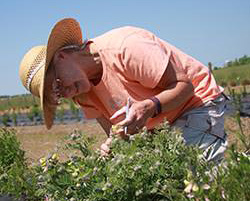 About Dr. Joan Walker
Dr. Joan L. Walker is Research Plant Ecologist at the USDA Forest Service, Southern Research Station in Clemson, Southern Carolina. She received her PhD in Biology from the University of North Carolina at Chapel Hill. Her current research focuses on studying the population dynamics, breeding system, habitat requirements of and fire effects on rare plants in longleaf pine communities.Specifically, she is working on Macbridea alba, Harperocallis flava, Scutellaria floridana, and Echinacea laevigata.


 Loading