Sponsor Img Consumer Benefits of Grass-fed Beef

Corner Down Image
Rated 3.8 out of 5 stars by viewers. 11 viewer ratings.

Green Savings!

Corner Down Image

Click on the graph below for a detailed Green Savings analysis of this event.


Webinar Details

Corner Down Image

When:

Jan 26, 2011 2:00 pm US/Eastern

Length: 01:15   (hh:mm)

Advance Registration NOT required.

View now on-demand.

Reviewed for Continued Content Relevance: 08/2016

Presenter(s):

  • Susan Duckett, Ph.D., Professor of Animal Science, Clemson University, Clemson, SC

CEU Credits/Certificate Offered:

  • American Registry of Professional Animal Scientists (ARPAS) - 1 hour ARPAS Credit
  • Certificate of Participation
  • Conservation Planner (CP) - 1 hour Conservation Planning Credit

Virtual Event Format:

Group Viewing Available:

You can view this webinar now on-demand.


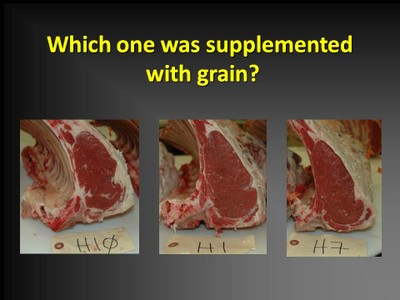
The health benefits of grass-fed beef are presented to help land managers and conservation planners promote improved grazing management on pastureland.

Most people are aware of the environmental benefits of grass-fed beef operations, including reduced energy costs, and potential water and soil quality improvements. Less is known, however, about the human health implications of grass-fed beef. The nutritional benefits of consuming grass-fed beef are compared to those from consuming beef produced using traditional methods, providing land managers and conservation planners with knowledge and a new perspective with which to improve grazing land management.

This webinar is sponsored by the USDA NRCS East National Technology Support Center.
Grass-fed Beef image

Need Help!

Live captioning transcript is available upon request.

For information on connecting to the webinar or setting up YouTube - Embedded Video, please check out the FAQ section. If you continue to have issues connecting to the webinar or if you're having trouble with this website, contact us at contact@sref.info.

If this webinar is a standard portable media file format such as (.mp4, .avi, .mov, .flv) or a Microsoft Windows Media File (.wmv), you will need to have the Windows Media Player, Apple Quick Time Player, Real Player or other media player installed on your computer to view/play the webinar file. Depending on your internet browser, you may need to install a media player plug-in for your browser.

NOTE for Mac / ios users: if the webinar format is .wmv (a Windows Media File), you may need to install a 3rd party .wmv viewer on your computer such as Flip4Mac before you can playback this media file format.


SPONSORS:

  • Southern Regional Extension Forestry
    Southern Regional Extension Forestry
  • USDA NRCS
    USDA NRCS
  • NC State University Extension
    NC State University Extension
  • USDA Forest Service
    USDA Forest Service
  • The University of Georgia
    The University of Georgia

CONTACT:

COMMENTS & QUESTIONS

Full Name:

Email:

Message:


For the latest up-to-date live and on-demand agriculture webinars, videos, training, and events from the US Department of Agriculture, State Ag Divisions, University Cooperative Extension, and other notable agriculture organizations, visit the Agriculture Webinar Portal
For the latest up-to-date live and on-demand forestry and natural resource webinars, videos, training, and events from the USDA Forest Service, State Forest Divisions, University Cooperative and Forestry Extension, and from other notable forestry related organizations, visit the Forestry Webinar Portal
For the latest up-to-date live and on-demand conservation of natural resources webinars, videos, training, and events related from the USDA Natural Resource Conservation Service (NRCS), State Conservation and Natural Resource Divisions, University Natural Resource Extension, and other notable conservation and natural resource organizations, visit the Conservation Webinar Portal

Loading