
Low-water Crossings for Livestock and Equipment


Webinar Details
When:
Aug 31, 2011 2:00 pm US/Eastern
Length: 00:56 (hh:mm)
Advance Registration NOT required.
View now on-demand.
Reviewed for Continued Content Relevance: 08/2016
Presenter(s):
- Kale Gullett, Fisheries Biologist, USDA NRCS East National Technology Support Center, Greensboro, NC
CEU Credits/Certificate Offered:
- Certificate of Participation
- Conservation Planner (CP) - 1 hour Conservation Planning Credit
Virtual Event Format:
Group Viewing Available:
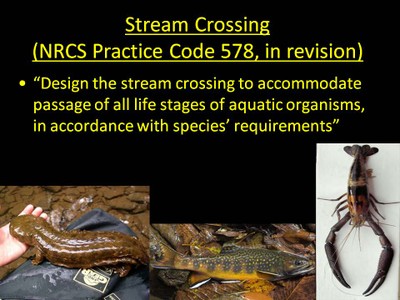
Gain insight into evaluating producer operations, watershed context, and stream geomorphology to assist in the planning and design of stream crossings that promote aquatic organism passage, conservation biology, stream continuity, and habitat quality.
Low-water crossings on low-volume and farm access roads are a common feature on many working lands. While intended to serve as safe stream crossings for both equipment and livestock, they can present construction and maintenance problems, often alter channel form and function, and may challenge up- and downstream passage for migratory aquatic organisms. As desirable alternatives to culverts and bridges, low-water crossings can also offer environmental and operational advantages to landowners on low-volume and private roads and trails. This webinar reviews the ecological and geomorphic effects of low-water crossings in stream environments, presents guidance for selecting structures that minimize disruption of channel processes and habitats, summarizes basic design parameters and requirements, and presents selected examples that illustrate performance, problems, and advantages of different types of low-water crossings.
This webinar is sponsored by the USDA NRCS East National Technology Support Center.
Internet Explorer plays captions for this webinar.


 Loading