
 Stream Simulation Culvert Design and Performance: A USFS Perspective


Webinar Details
When:
Jan 30, 2013 2:00 pm US/Eastern
Length: 01:31 (hh:mm)
Advance Registration NOT required.
View now on-demand.
Reviewed for Continued Content Relevance: 08/2016
Presenter(s):
- Paul Anderson, Forest Engineer, U.S. Forest Service, Washington Office Engineering
- Dan Cenderelli, PhD, Geomorphologist/Hydrologist, U.S. Forest Service, Stream Systems Technology Center
- Mark Weinhold, Forest Hydrologist, U.S. Forest Service, White River National Forest
CEU Credits/Certificate Offered:
- Certificate of Participation
- Conservation Planner (CP) - 1 hour Conservation Planning Credit
Virtual Event Format:
Group Viewing Available:
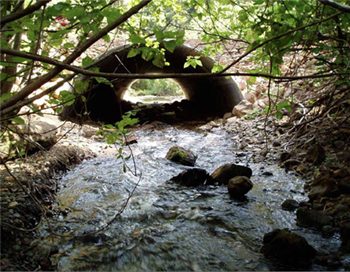
Aquatic organism passage at road-stream crossings has been the subject of engineering, fisheries, hydrology, and wildlife specialists’ concern for many decades. This webinar will introduce the concept of stream simulation design and provide an overview of the components of assessment, design and construction of a stream simulation design road-crossing structure.
Over the past 10 years, the U.S. Forest Service and other partners have developed an approach to designing stream crossings that improves stream crossing performance by reducing blockages and wash-outs during storm events, and improves aquatic habitat by eliminating barriers to fish and other aquatic organisms. Stream Simulation Design is the required standard for U.S. Forest Service roads. The premise of stream simulation design is that by creating channel dimensions and characteristics through a road-stream crossing that are similar to those in the natural channel, fish and other aquatic organisms will experience no greater difficulty moving through the structure than if the crossing did not exist.
Undersized culverts led to millions of dollars of damage and long-term road closures in the northeast during Tropical Storm Irene in August 2011, however, stream crossings recently installed with stream simulation design survived without damage. U.S. Forest Service and partners are currently examining economic impacts of undersized culverts during Irene and the life cycle costs/benefits of using the Stream Simulation Design approach.
This webinar is sponsored by the USDA NRCS East National Technology Support Center.


 Loading